2015 S1KRR ON DYNO

The 2015 BMW S1000RR MADE 196 BHP ON DYNO . Read more ...

The New Ducati Scrabler

Ducati’s eagerly anticipated Scrambler is being launched today in sunny California in the hands of Senior Road Tester Adam Child. Here’s what Adam had to say about the all new Ducati . Read more

The 2015 Norton Dominator

The legendary Norton Dominator name is set to return as Norton announce they are already taking orders for a new, road-legal version of their Domiracer .Read more

2014 v 2015 BMW S1000RR

BMW claims their new, third-generation S1000RR is lighter and more powerful than ever. We’re putting that to the test by pitching the new machine against the out-going model.
We’ll speed test both Beemers and strap them to our dyno to see if the new bike really does makemore power at the back wheel and if it can get close to the German firm’s claimed 199bhp power figure.
We’ve already ridden the 2015 S1000RR on-track at its launch in November and we were amazed by its easy speed, but to find out if it behaves itself just as well in the real world, we’ll also be riding it on the road… so it’s a good job it has heated grips!

One killed in Kenly motorcycle wreck

 51-year-old man died this afternoon after a crash on a motorcycle he was riding  on Tedder Road near Kenly.

Tony Helms,  was test riding a motorcycle , he was repairing it for a friend when he lost control on a curve, ran off the road to the right, struck a ditch and overturned several times, the N.C. State Highway Patrol said.


Helms, who was not wearing a helmet, was thrown from the bike. He was pronounced dead at the scene, troopers said.

Light rain was on the roadway when Helms crashed. Speed was a factor, troopers said.

The 2015 Kawasaki ZX-14R and 1984 Ninja 900

Introduced in ’84, the first Kawasaki to bear the Ninja name featured a variety of other firsts. At a time when manufacturers were experimenting with engine configurations other than the previously (and now) standard inline four, the 900 was the first motorcycle with a liquid-cooled inline four. According to Kawasaki’s online museum, the company had considered and tested V-four and inline six-cylinder configurations, but settled on a narrow, lightweight inline four – even though at the time Honda’s V-four engines were looking like the future.

Other innovative firsts including moving the camchain to the left end of the cylinder block as opposed to placing it in the center, making the engine narrower and evening up the cylinder spacing to make the ports straighter. The alternator was mounted behind the cylinders to keep the engine narrow, and a gear-driven counterbalancer, six-speed gearbox and hydraulic clutch were all used. And while other manufacturer’s were going bigger and heavier (think Honda Interceptor 1000, Suzuki GS1150, Yamaha FJ1100 and Kawasaki’s own GPz1100), Kawasaki was willing to sacrifice outright power to keep weight down. The Ninja’s engine wouldn’t be too far out of place in today’s world, and many of its features are now the sportbike standard.

The Ninja’s frame was just as innovative. It’s “diamond” design was Kawasaki’s first to use the engine as a stressed member for a large-displacement machine. While the main frame was made from conventional (at the time) round-tube steel, the subframe was a bolt-on piece made from square tubing.

 Consider too that while other sportbikes had smallish fairings and separate belly pans for bodywork, the Ninja had a full fairing at the front and a wraparound tailsection that covered the frame and subframe tubing completely. The remainder of the chassis was fairly conventional for the time: A 16-inch front/17-inch rear wheel combination, an air-assisted anti-dive front fork and Uni-Trak rear suspension.
In Motorcyclist magazine’s April ’84 test of the 900 Ninja, the headline reads, “Suddenly, your two-year-old sport bike is ten years old,” an indication of the step forward the bike represented. While the industry was in the midst of a quarter-mile war at the time – with manufacturer’s all hiring Jay “Pee Wee” Gleason to ride the bikes and the results plastered in two-page ads everywhere – the Ninja 900 gave away some displacement and power to the other bikes. 

Motorcyclist’s Road Test Editor Jeff Karr posted a 10.96-second run, about two-tenths slower than the then-king Suzuki GS1150. Still, the editors raved about the Kawasaki’s power and handling, with this statement closing the test: “The Ninja is a very exciting motorcycle, a leap forward for large-displacement sporting bikes. If you think the essence of motorcycling is the sensation of leaning into corners, you need one.”
The Ninja's notoriety grew its appearance with Tom Cruise in the movie Top Gun in 1986, the same year in which the next performance Kawasaki was introduced. That bike was dubbed the Ninja 1000R and otherwise known as the ZX-10. While the Ninja 900 wasn't imported into the U.S. after that year, it continued to be produced for other markets until 1996, with various upgrades along the way.


Only 300 units of this special-liveried ZX-14R will be built specifically for the American and Latin American markets according to Kawasaki (an additional 30 units will be built for the Canadian market).


Other innovative firsts including moving the camchain to the left end of the cylinderblock as opposed to placing it in the center, making the engine narrower and evening up the cylinder spacing to make the ports straighter. The alternator was mounted behind the cylinders to keep the engine narrow, and a gear-driven counterbalancer, six-speed gearbox and hydraulic clutch were all used. 
And while other manufacturer’s were going bigger and heavier (think Honda Interceptor 1000, Suzuki GS1150, Yamaha FJ1100 and Kawasaki’s own GPz1100), Kawasaki was willing to sacrifice outright power to keep weight down. The Ninja’s engine wouldn’t be too far out of place in today’s world, and many of its features are now the sportbike standard.
Kawasaki is celebrating 30 years of Ninja models in 2015 with special anniversary editions of the ZX-10R, ZX-6R and ZX-14R. Scroll through the gallery above to see more images of the ZX-14R as well as the original Ninja, the 1984 GPz900R, and to learn more about both bikes.


  • Gold pinstriping defines the ZX-14R 30th Anniversary Limited Edition's painted areas, and the radial-mount Nissin four-piston calipers are also finished in gold. Mechanically, the 30th Anniversary Edition ZX-14R will be identical to standard model, with the same monstrously powerful 1,441cc four-cylinder engine equipped with traction control and three different riding modes, and the same aluminum monocoque frame with fully adjustable suspension and ABS.

2015 MV Agusta F4 RC Confirmed – $46,000

One of the more surprising things to come from MV Agusta USA’s price sheet for its 2015 models is the confirmation of the MV Agusta F4 RC superbike — a bike that had been leaked ahead of the 2014 EICMA show.
MV Agusta hasn’t publicly released details on the F4 RC yet, though leaked information points to a homologation special styled superbike with over 200hp.


Expected to cost €40,000 in the European market (the price cap for WSBK racing machines), American enthusiasts will enjoy the MV Agusta F4 RC’s $46,000 price tag in the United States.
If rumors are true, we can expected a 210hp machine that weighs 386 lbs dry. Since WSBK and similar superbike regulations are pushing engine development freezes from production models, we can expect MV Agusta to build out the F4 RC’s motor quite extensively for consumers.
As such owners can expect a new cylinder head, crankshaft, camshaft, while also using bigger fuel injectors, lighter pistons, and titanium connecting rods.
Other go-fast parts will be standard too. Expect to see Öhlins suspension, Brembo brakes, and a titanium exhaust from Termignoni.
We’re not sure why MV Agusta has been mum until now about the F4 RC project, but now that the cat is out of the bag, it shouldn’t be long until the Italian marque announces its race bike platform.
Source: MV Agusta USA

KTM RC 390 CUP PRICE CONFIRMED

RACE SERIES REGISTRATION OPENS WITH FREE SECOND SET OF WHEELS
• RC 390 Cup race bike - £6,425.00 (plus VAT)
• Race series entry fee - £2100, including personal accident cover
• Payment plan available for entry fee, spread over four payments
• Secure your place

on the grid with £300 deposit
• Register before January 16th to receive free second set of wheels
• Series calendar confirmed 

Registration for the Santander Consumer Finance KTM British Junior Cup is now open with the price of the bike confirmed at £6,425.00 (plus VAT) and a race entry fee of £2100, including personal accident cover.
Open to riders aged 13-18-years old; the series will provide every competitor with an identical ‘Cup’ variation of the recently-launched KTM RC 390. Promoted by MSVR, the series has been created to provide equal opportunity and a level playing field for emerging talent and will be spread across eight events incorporating 20 points-scoring races. Two official tests, subject to confirmation, are also planned in March 2015.
Fitted with a wide range of performance-enhancing KTM PowerParts, such as fully adjustable WP Suspension and an Akrapovič exhaust, the race specification bike costs £6,425.00 (plus VAT) and is only available from a KTM dealer. 
The series registration costs £2100 and requires interested riders to put a deposit of £300 down to activate their inclusion for the championship atwww.bsbteams.com. An available payment plan for the series fee, which also includes personal accident insurance, then requires three more payments of £600 each in March, June and August.
Riders and teams committing to their inclusion to the series before January 16 will also receive an additional set of wheels*, ideal for fitting with wet weather tyres.

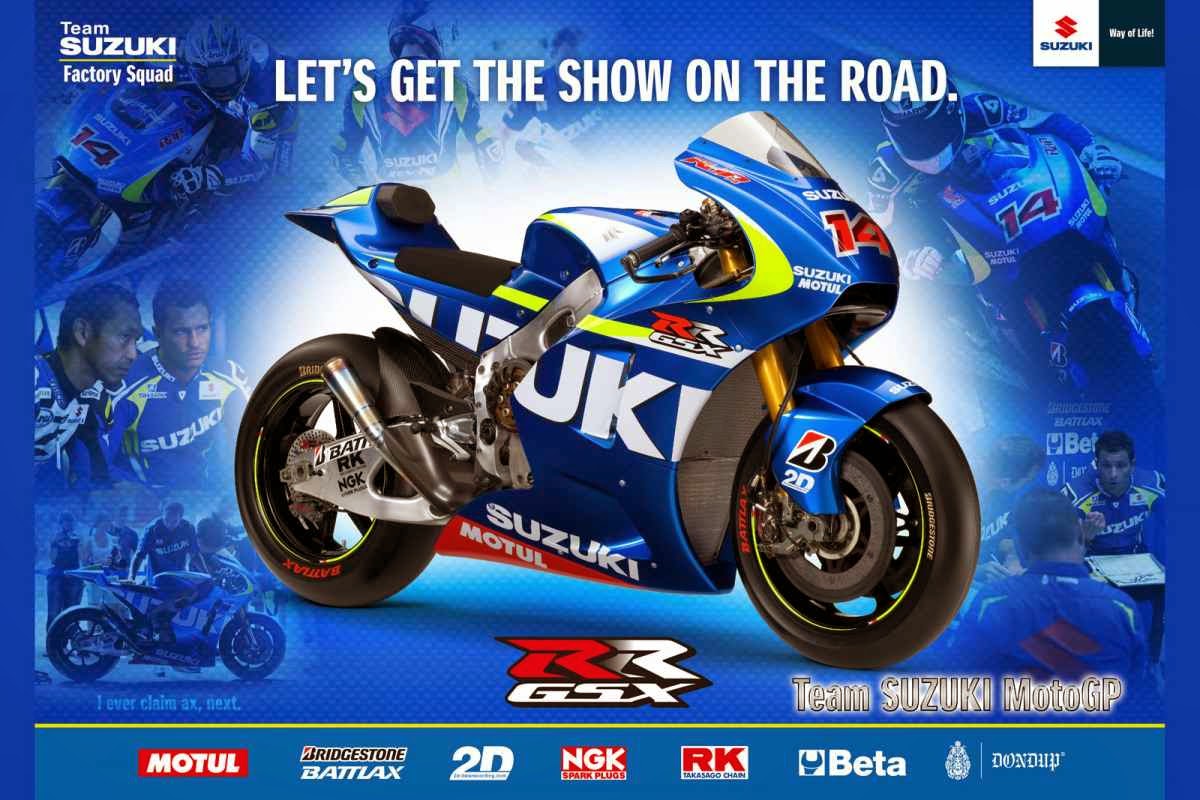
The 2015 SUZUKI GSX-RR MOTOGP BIKE

Suzuki continues to prepare for its full-time return to the MotoGP series


The GSX-RR is a 1000cc transverse, inline four-cylinder machine, whereas the previous machine, the GSV-R, was an 800cc V-four. Suzuki claims the new bike has more than 230 horsepower. Suspension is by Ohlins, brakes are Brembo units. Team Manager Davide Brivio explains the reasoning behind the switch to an inline configuration: “Well, to be also closer to our production bikes. One of the aims of participation in MotoGP is to develop technology to transfer to production bikes. So using the same engine layout there means stronger links to our production. That’s the target; the aim.”

Suzuki has been preparing for its return to MotoGP full-time for close to two years now, with continued testing and development of the all-new GSX-RR. We've gathered up this gallery of 12 shots of the new bike during testing and the official release held at Motegi in October. Scroll through the gallery above to see the images and learn more about the GSX-RR and Suzuki's return to MotoGP competition.


Norton rotaries fire up at the London Motorcycle Show

Ten of the most famous Norton rotary engined race bikes will be roaring into life at the London Motorcycle Show this February 13-15 as they’re fired up on stage by some of the original riders!

From the prototype RC588 to Hislops TT winning NRS588, the rotary Nortons were the icons of a fabulous era in British motorcycle racing history. The machines captured the imagination of the British public with ingenious engineering, subtle rule bending and some charismatic riders.
Steve Hislop, Ron Haslam, Steve Spray, Trevor Nation, Ian Simpson and Terry Rymer all rode the Nortons in some of the most memorable and epic battles of the era.
Who could forget Hizzys victory over Fogarty and Joey at the 1992 TT? Or the famous JPS liveried bikes or Spray and Nation wheeling over the mountain at Cadwell Park during the 1989 British F1 championship?

Now, for the first time ever, the bikes, riders and engineers will come together at the ExCel centre in London to tell the story of this legendary British race team. With ten of the most famous bikes, key team personnel and the bikes being fired up inside the hall! it’s a British celebration you won’t want to miss

Spied: KTM Dukes Get Overhaul

Spy shots have emerged that suggest KTM’s excellent naked Duke range is under further development, presumably to refresh the 2016 model range.
KTM 125
KTM 125
The 125, 200 and 390 Dukes have been tricking into the marketplace since the 125’s launch in 2011. We don’t get the 200 in the UK, but the 125 and 390 have been strong performers for team orange.
The engines give them away as being the 125/200 and the 390, and there’s no obvious sign that the firm has made changes to either mill.
The obvious area under development is the rear subframe, which is new in both instances, and – at this stage – is a bolt-on affair, whereas the current bikes’ is welded in place. This may be to make the bikes more crash resistant for learners, or could simply be for prototyping.
KTM 390
KTM 390

The rear number plate hangers and positioning of the rear indicators is also revised, while the only other visible changes of note are revised rider rearsets, and a large side-mounted exhaust on the 390 test mule. It’s unclear why the 390 would move away from the underbelly exhaust, unless it’s to help distinguish it as the bigger bike, or it may be for exhaust or noise emission reasons.
KTM told MCN: “It’s difficult to comment on the image of the Duke other than as a current model, the model will be seen undergoing common durability testing, as is the norm.”
We’d expect to see any revisions unveiled at the 2015 EICMA show in Milan, making these 2016 models.

Santa's From Kosovo with Supermotos + Burnout in front of the Police VIDEO


This is a group of guys from kosovo who dressed with santa clothes and ride supermotos , Perfect idea and combination + Burnout in front of the Police VIDEO :) 


Triumph Street Tracker

Triumph's new Bonneville-based Street Tracker, which is due to go on sale in 2016, has been spied testing on the roads of Spain. These new spy shots also confirm for the first time that there will be more than one version of the Street Tracker.

These pictures show a standard model, and one with higher specification brakes and suspension. Assuming Triumph employ their normal naming conventions, this will be the Street Tracker R.
It's the first time in nearly two years that MCN's spy photographers have caught sight of the bike. They last captured images of it in the engineering mule stage, but since then virtually nothing has been seen or heard of the bike.


The Street Trackers will use an all-new engine that takes the current Bonneville motor and gives it a massive hike from 865cc to around 1100cc, which is expected to take power close to 90bhp.
MCN sources suggest the whole Bonneville range will benefit from changes, with heavy revisions also due for the 865cc motor.


Triumph's Street Tracker R is expected to come in fairly close on price to BMW's R nineT, which costs £11,750. This will make it a strong option for those who want the classic style of the Bonneville but demand more oomph. The standard bike shouled be about £1000 less than that.
Credits : MotorcycleNews.com


Perth’s new undercover police bikes catchout careless drivers

Amazing video how a Perth’s new undercover police bikes catchout careless drivers , must watch

Post by Cycle.


First ride: Ducati Scrambler

Ducati’s eagerly anticipated Scrambler is being launched today in sunny California in the hands of Senior Road Tester Adam Child. Here’s what Adam had to say about the all new Ducati.
"We’ve flown all the way to sunny California to test ride Ducati’s all new Scrambler. We’ve been given the chance to ride the new Icon model which will cost £6995 when it arrives in the UK early next year.
"Each model shares the same 803cc air-cooled V-Twin from the 796 Ducati Monster. The bore and stroke remain the same but the valve overlap has been reduced which should smooth out the power delivery. Ducati are quoting 75bhp at 8250rpm and 5.2ftlb of torque at 5750rpm.

"Each model also shares the same twin spar trellis frame and the same suspension, inverted 41mm front forks and a side mounted single rear shock, both adjustable for preload only and produced by Kayaba.
"Each model features new chunky enduro-style Pirelli MT60 rubber specially designed for the Scrambler. In all there are four different models to choose from, the Icon, Classic, Full Throttle and Urban Enduro, each one styled slightly different but using the same base.

"Prices start at £6895 for the Icon in red then £6895 for the yellow. All other variants are £7995. The Icon will be in dealers in February with all other models following in Mach and April. There’s also a huge list of accessories to personalise and create your own bike along with a huge list of clothing.


The 2015 Yamaha R1 With Race Bodywork

Here is Yamaha's work-in-progress superbike with race bodywork, rapid prototype tank with larger volume, and R1M-culled carbon fiber front fender. The team expects to run its first test with the new bike after the first of the year.


Have a little mercy on the Yamaha Motor USA racing team. For six years now, the team has steadily developed the original crossplane-crank R1 into a mount that’s all but dominated the AMA SuperBike category. Now, not only is the team tasked with putting together a winning program for the all-new MotoAmerica series, but it’s also having to develop an all-new motorcycle.
“We almost couldn't get something at a worse time, but were working through it and it’s coming along really good,” says Racing Division Manager Keith McCarty during a recent trip to Yamaha Motor Racing headquarters. During that stop, we had the chance to take a peek inside the team’s race shop to see just how well the project was coming along.
While we continue to drool over Yamaha's redesigned 2015 R1, the Yamaha Motor USA team has already stripped one down and begun building its next superbike. Presumably, this little R1's engine is off to the engine room.
While there’s still a long ways to go, the team has already made some serious progress. The bike on the team's lift is already outfitted with a rapid prototype tank, for example, which has a larger volume and been shaped by Yamaha engineers (in house) to look like the standard tank. “We’re fitting the dash and intake, front fender, and brakes. All of the things that we'll be changing to make it a superbike, we’re going through that right now,” says McCarty.
The superbike's front cowling has been changed a bit, and the bike is currently adorned with a stock R1M carbon fiber front fender. McCarty goes on to say that the team is "just scratching the surface on [the engine]."
Yamaha’s first official test on the superbike will be after the first of the year, “but we’re hoping to get Cameron [Beaubier] out late this year on the production bike and just get him to get a feel for it,” admits McCarty. "We’re a small group of people doing this. There's only five or six people on this project, so it's tough," he adds, bearing in mind that the MotoAmerica series kicks off April 12 at Circuit of The Americas.
Ironically, one of the other bikes parked in the team's shop is last year’s race bike. Some assurance that if anyone can get the job done, it’s the Yamaha Motor USA race team.
More photos of Yamaha's work-in-progress 2015 R1 superbike below.


The 2015 Norton Dominator


The legendary Norton Dominator name is set to return as Norton announce they are already taking orders for a new, road-legal version of their Domiracer.
These images direct from the Norton design department are the first chance to see the new bike and what it will look like. At the moment there isn’t a real bike fully built but these are official Norton drawings of how the Dominator will look when it goes into production early in 2015.
The new Norton Dominator has been inspired by the huge success of the £25,000 Domiracer which was limited to just 50 bikes and sold out in less than a week; secondhand examples are now changing hands for up to £40,000.
The demand for the hardcore, track-only Domiracer has shown Norton there is a huge demand for such a bike and nearly 40 of the 50 bikes sold have been registered as road bikes using Single Vehicle Approval (SVA) legislation.


The new Dominator is a toned-down version of that bike; keeps much of the basic Domiracer engineering but this will be a fully type-approved and road-legal bike that meets strict Euro3 emissions and noise regulations.
Norton has already opened the order books for some of those who were desperate to get hold of a Domiracer in 2013 but missed out on the 50 bikes built. The order books are open but Norton doesn’t even yet know exactly when production will begin but it’s estimated it will be late February 2015.
Garner told MCN: “The Domiracer has been so successful for us we had to do this. The demand for the Domiracer has been unbelieveable and even though we always said there were only ever going to be 50 of them we still get people phoning every week asking if someone had dropped off the list.
“We have seen a few selling on the used market for more than £40,000!
“What we are thinking is that there will be a run of 50 Dominator SS bikes to start with before it then turns to building standard bikes which will be named Dominator. Some of those who missed out on the Domiracer have heard about this bike and have already been trying to give us cash deposits. At the moment we are telling them to hang onto their money until we get more of a clear idea of when production will start.”
The new Dominator has some key changes over the Domiracer it is based on; most as a result of the reduced price of £19,999 which has demanded some of the most expensive elements of the Domiracer have been changed. Norton wants to make sure owners of the original 50 bikes are clear the bikes they bought are still special and aren’t going to be followed by a whole load of cheaper but identical bikes built for the road.

Finally Revealed at 2015 EICMA : Honda CRF 1000 F Africa Twin


Honda are continuing the build-up to the launch of the all-new Africa Twin next year with the second in a series of videos exploring the history of the famous name.
Despite the firm heavily falling back on the road and racing history of the famous Africa Twin name the company is still insisting on calling the bike True Adventure; the name the concept bike shown at the Milan show and then later at Motorcycle Live in the UK was called.
'Episode 2 is called “Live Unlike The Others” and Honda says it “focuses on the personal stories of individuals who have all been inspired by the spirit of adventure in their own way. All riders featured are real people, with real stories and many of them are currently on adventures around the world, aboard their Honda motorcycles.”
The first video covered the Paris-Dakar rally racing heritage of the Africa Twin from the heyday of the racing in the 1980s when it was still racing across the desert of Africa.
The new Africa Twin is set to be shown in full finished form in 2015 to go on sale in 2016 according to Supermotoo sources.


Yamaha R6 Smiley Burnout (Pics)


2015 BMW S1000RR: 198bhp on the dyno!!

Some of the UK's first 2015 BMW S1000RRs have already been tested on dynos and are producing 198bhp at the back wheel.
Race teams are starting to receive their new-model 2015 BMW S1000RRs in preparation for the coming season.


Prime Factors Racing, who will be contesting the World Endurance Championship next year with Gary Mason, Lee Johnston and Stefan Capella, are running their first S1000RRs in on the dyno and have already witnessed impressive power figures.


Bruce Charman, Prime Factors’ managing director explains: “The first of our RRs we’ve put on our dyno, with bog stock tyres and exhaust, is already making 198bhp at the rear wheel.

“Last year our HP4s with which we won the ACU National Endurance championship with produced 186bhp in stock trim and we got those up to 195bhp by the end. We expect to see well over 200bhp by the time the bike is fitted with a race exhaust and fully run-in.”


Honda’s supercharged NC750

It’s easy to see Kawasaki’s supercharged H2 as little more than a toy for the wealthy, but the supercharged technology it sports could be a taste of the future for far more mundane machines.
Looking at the layout shown in Honda’s patent drawings based around the NC750 parallel twin, it seems likely that supercharging has been in the firm’s plan ever since the NC750 was first mooted.
The near-horizontal cylinders, which allow for a large luggage space under the dummy fuel tank on the normal NC750S and NC750X, mean there’s plenty of room to sit a crankshaft-driven supercharger and all its related pipe work on top of the engine. While that eliminates the storage space, it means the bike isn’t compromised elsewhere.
Importantly, there’s even space for a large intercooler, which Kawasaki’s H2 lacks. Intercoolers are useful on any forced-induction engine because the act of compressing the intake air also creates a lot of heat. Hot intake air is less dense than cold air, harming performance. With an intercooler, boost can safely be increased.
On the Honda designs, which were drawn up before the Kawasaki H2 appeared, the supercharger is mounted in a similar position to the Kawasaki’s, just behind the cylinders. It takes air from an airbox between the rider’s legs, compresses it and feeds it forwards into an air-to-air intercooler under the front of the dummy fuel tank.
As on the normal NC750, the real fuel tank is under the seat. The intercooler is effectively a radiator, but instead of water it’s the intake air that runs through it. Cold air, coming in through an intake on the front of the bike, runs over the intercooler’s fins, drawing heat away.
After it’s been cooled, the compressed intake air is rushed into a plenum chamber, which is a pressurised storage tank that removes pressure waves and surges from the air and means there’s always a supply of compressed air ready when the throttle is opened.
The plenum chamber has two outlets: the main one feeds into the engine’s throttle body, where fuel is added before it reaches the cylinders, while a second outlet is fitted with an electronically-controlled bypass valve so if the pressure in the chamber gets too high, the engine management system can release some air from the system. Cleverly, the released air goes back into the supercharger rather than simply being vented.
Just how much performance the supercharger will add is going to be largely down to the way it’s set up. However, it’s easy to imagine that it could double the stock NC750’s power, making it a 100bhp machine that would still retain most of the normally-aspirated version’s astonishing fuel economy and low emissions.
Given that the first patents relating to Kawasaki’s H2 appeared nearly four years ago, we could still face quite a wait before seeing the fruits of Honda’s labours in showrooms.
The real reason for supercharging
While supercharged or turbocharged engines are inherently glamorous thanks to their big power outputs, there are two far more sensible reasons for their increasing popularity: emissions, and economy.
Kawasaki’s H2 demonstrates some of the more subtle advantages of supercharging. Some have questioned the road version’s seemingly ‘low’ power because its claimed output is identical to the normal ZX-10R, but newly-released American emissions documents for the bike reveal it scores massively well when it comes to cleanliness.
The H2’s hydrocarbon emissions are down from the ZX-10R’s 0.3g/km to 0.2g/km – an impressive 33% improvement – while the carbon monoxide level drops from 3g/km to just 1g/km. Those are serious improvements for an engine that loses no power and which also benefits from a hefty boost in torque.
While both surpass current emissions requirements, it’s also clear which one will be better placed to fend off future restrictions. The implication of the H2’s lower CO and HC emissions are that it will also be more fuel efficient, at least under part-throttle conditions as in the emissions test (and, most of the time, the real world).
The H2 may still be a rich man’s toy, but its emissions point very clearly to where the next-generation of everyday bikes are likely to be headed.